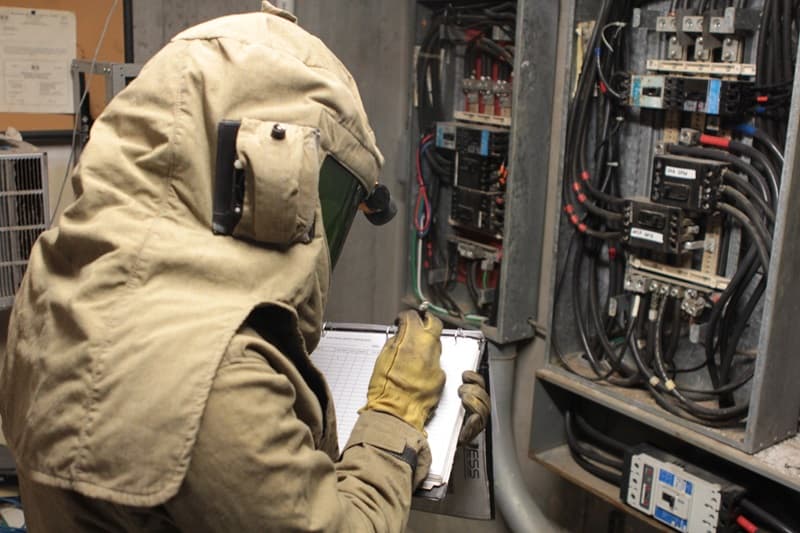
An arc flash study turns your electrical distribution system into documented hazard levels, approach boundaries, and PPE requirements workers can use on the floor. NFPA 70E expects that analysis to reflect what is actually installed—not a generic template.
Below is the seven-step process Plazmaa follows for industrial and commercial facilities. The same model supports short-circuit, coordination, and arc flash calculations so labels, settings, and training stay aligned.
Step 1: Acquire documentation or build electrical one-lines
We start by requesting whatever you already have: electrical one-line or riser diagrams, power floor plans, equipment schedules, and protective device settings.
That baseline tells us how complete the system model is and helps scope the project. Outdated drawings get corrected during field verification. If nothing exists, we build the one-line from the survey.
Step 2: Field verification
We schedule a site visit. Degreed electrical engineers walk the system—typically starting at the utility service entrance and working downstream.
Crews verify equipment nameplates, feeder sizes, protective devices, and connections. Covers are removed where safe and permitted so breaker frames, trip units, and conductor terminations match the model. Data can be captured on hard-copy sketches or with electronic survey tools that feed directly into study software.
Step 3: Load information into the system model
Verified data is entered into power-system software (SKM, EasyPower, or equivalent). Device types, cable lengths, transformer impedances, and utility fault contributions must match the field.
A structured QA/QC review catches transposition errors before any calculations run. Garbage in still means garbage out—this step is where accuracy is won or lost.
Step 4: Run the short-circuit study
The first calculation pass is the short-circuit study. It determines available fault current at each bus and piece of equipment.
Results are compared to each device’s interrupting rating or AIC (ampere interrupting capacity). Three-phase and line-to-ground values are checked so gear can safely clear a fault without catastrophic failure.
Step 5: Perform the coordination study
Next comes protective device coordination: time-current analysis to confirm the device nearest a fault clears first.
In a well-coordinated system, upstream breakers should not trip for a downstream event—limiting outage area. Extra attention goes to life-safety, emergency, and generator scenarios where selective tripping protects critical loads.
Coordination and arc flash sometimes pull in opposite directions; both must be evaluated explicitly rather than assumed.
Step 6: Evaluate arc flash (incident energy)
With fault current and clearing times established, we calculate incident energy (often in cal/cm²) and arc flash boundary distances at each analyzed location, typically per IEEE 1584 methodology.
Short-circuit magnitude drives how much current can flow in a fault. Coordination determines how long protection takes to open. Together they define the severity workers face at each piece of equipment.
Step 7: Labels, PPE, system review, and training
The final deliverable package usually includes:
- Arc flash labels for each studied device (nominal voltage, incident energy or category, boundary, PPE level)
- Recommendations to lower incident energy where practical (settings changes, maintenance modes, equipment upgrades)
- An updated one-line diagram and engineering report
- NFPA 70E training so qualified workers can read labels, select PPE, and follow energized work rules
Supervisors and electrical staff should understand what the numbers on the label mean—not just which suit to grab.
How the steps fit together
| Phase | Primary output | |-------|----------------| | Documentation & survey | Accurate system model | | Short-circuit | Fault current vs. equipment ratings | | Coordination | Selective tripping behavior | | Arc flash | Incident energy & boundaries | | Closeout | Labels, report, training |
Skipping field verification or using obsolete one-lines is the most common reason labels fail audits—or worse, under-protect workers.
What drives project cost and timeline?
Scope depends on equipment count, system voltage levels, drawing quality, and site access. See our companion article on factors that affect arc flash study cost.
Upfront study cost is small compared to the cost of an unmitigated arc flash event: injuries, equipment damage, downtime, and liability.
Related reading
- Arc Flash Risk Assessment: What It Is and Why It Matters
- Coordination Study vs Arc Flash Study: Key Differences
- When Do You Need a Short-Circuit Study?
- Arc Flash Label Fields Your Team Should Understand
Ready to start?
Plazmaa delivers arc flash studies, labeling, and NFPA 70E training from Austin, TX—with onsite support nationwide. Request a quote or review our arc flash study services.